
The Situation
Many companies today are facing serious personnel challenges. The symptoms are varied:
• High employee turnover
• Low willingness to take on additional tasks
• Poaching by competitors
• New team members who lack initiative
• And not least: a general shortage of skilled workers
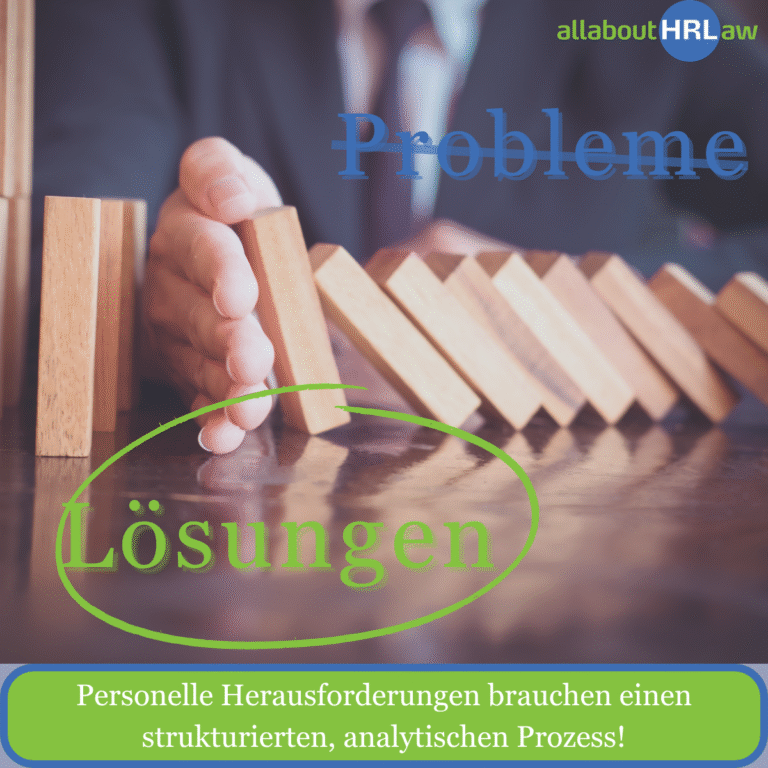
At first glance, these problems may seem like insurmountable obstacles. Yet in human resources, one principle always applies: every challenge has a solution – sometimes unexpected, but always achievable.
The Key: Structured Analysis Instead of Gut Feeling
In many organizations, HR topics are still viewed as “soft issues” and therefore not treated with the same systematic rigor as financial or operational questions. But the same rule applies here: only a structured, analytical process creates clarity and enables sustainable solutions.
Such a process includes:
- Precise problem definition – What exactly is happening?
Example: “Turnover among production staff within the first 12 months is significantly above average.” - Data-based analysis – Turnover rates, employee interviews, and industry benchmarking.
- Identifying root causes – Are the reasons missing development opportunities, unclear roles, lack of leadership, or external factors such as salary levels?
- Developing scenarios and solutions – From targeted training programs and employer branding initiatives to adjustments in leadership and organizational structures.
- Testing and evaluation – Solutions are piloted, evaluated, and scaled based on results.
The Role of HR
This is where the strategic role of HR comes into play. HR is not merely an administrative function – it is a driver and a shaper of change. The task of HR is to describe problems transparently, support them with data, and clearly outline possible solutions.
This has nothing to do with intuition or “soft skills” – it’s about professionalism and analytical thinking. In this way, HR becomes a business-critical partner, operating at eye level with company leadership.
Conclusion
Personnel challenges are more complex today than ever before. Turnover, lack of motivation, or competitive poaching are familiar symptoms across industries. But experience shows: with a structured, analytical process, there is always a solution. It may not always be the most obvious one – sometimes even a surprising one – but it exists.
Companies that consistently manage their HR work with data-driven and systematic approaches have a clear advantage: they not only find answers to current problems but also create a sustainable foundation for long-term success and resilience.