

Everyone knows there is a performance problem. Except the employee concerned.
Companies invest a great deal of time in performance management. They set objectives, conduct performance reviews and establish feedback processes. Yet when it comes to dealing with low performance, the same surprisingly simple problem arises time and again: a significant performance gap has long been recognised internally, but it has never been discussed clearly with the employee concerned.
Perhaps this is one of the biggest weaknesses in many performance processes. The problem is not that companies identify poor performance too late. It is that too much time passes between recognising the problem and having an open conversation about it.
A manager has been dissatisfied with a team member’s performance for months. Deadlines are repeatedly missed, work has to be corrected and tasks regularly end up back with the manager. The issue has already been discussed internally, and HR may be aware of it as well. The conclusion is clear: things cannot continue like this.
The only person who does not know how serious the situation has become is the employee concerned.
Conversations have taken place. But they have sounded something like this: “I’d like to see a little more initiative from you” or “You need to take more ownership here.” To the manager, these may seem like clear indications of a performance problem. To the employee, the same statements may simply sound like ordinary development feedback.
Months later, two very different perceptions collide. The company believes it has addressed the issue several times. The employee, meanwhile, feels as though they are hearing for the first time that their overall performance is being seriously questioned.
If an employee does not know that their performance is significantly falling short of expectations, the company does not just have a performance problem. It has a clarity problem.
For SMEs and startups in particular, this lack of clarity can quickly become costly. In small teams, underperformance rarely affects just one person. Managers spend more time checking work, colleagues take on additional tasks and projects are delayed. The result is what we might call Performance Debt.
What Is Low Performance – and When Is It Really a Performance Problem?
Low performance describes a significant gap between the performance expected of an employee and the performance they actually deliver. Not every mistake or period of weaker performance makes someone a low performer.
New responsibilities require time to learn. Targets may be unrealistic, resources may be lacking or priorities may conflict. In growing companies in particular, roles also evolve. What met expectations a year ago may no longer be sufficient today because tasks have become more complex or areas of responsibility have expanded.
Before describing a situation as low performance, companies should therefore define the gap between expected and actual performance as precisely as possible. What results were expected? Were those expectations reasonable and understandable? How long has the gap existed? What might be causing it? And did the employee realistically have the opportunity to deliver the expected performance?
In practice, however, performance assessments often remain abstract. Someone is said to lack “drive”, to be “not senior enough” or to show “too little ownership”. Such assessments may reflect a genuine issue, but they are not enough. A manager needs to be able to explain which specific behaviour or result is falling short of expectations.
Professional performance management therefore starts by examining the gap between expectations and results, rather than judging the individual.
The Real Problem: Companies Speak More Clearly Internally Than They Do with the Employee
The situation becomes particularly problematic when the performance gap has already been recognised internally. Managers or HR may discuss it in very concrete terms: the results have not met expectations for months, other team members are taking over tasks and the manager is spending too much time checking the employee’s work.
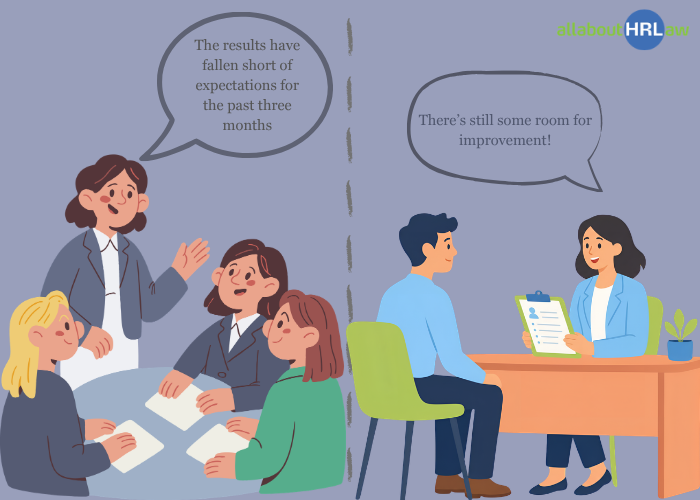
Yet in the conversation with the employee, the same situation suddenly sounds much less serious. “The results have not met expectations for the past three months” becomes “There’s still some room for improvement.” “At the moment, we can’t rely on you to deliver what you commit to” becomes “Please pay a little more attention to your deadlines in future.”
Respectful communication matters. But respect and clarity are not opposites. If a significant performance gap is expressed so cautiously that the employee cannot understand its importance, it creates a false sense of security.
Improvement requires clarity. Employees cannot solve a problem if they do not know that there is one.
Performance Debt: When Unresolved Performance Problems Become Increasingly Costly
Low performance does not disappear simply because no one addresses it clearly. In most cases, its effects are merely shifted elsewhere in the organisation. This is what we can describe as Performance Debt.
Performance Debt refers to the organisational costs that accumulate as a result of unresolved performance problems. Much like Technical Debt, these costs may initially seem insignificant. A manager checks a presentation one more time, a colleague takes over a client at short notice, or a project manager corrects a set of figures.
Over weeks and months, however, this develops into a significant burden. Managers lose time through additional supervision, colleagues have less capacity for their own work, mistakes create additional work and decisions are delayed. Eventually, HR also becomes heavily involved in a situation that could have been clarified much earlier.
The impact on high-performing team members is particularly critical. If the same people repeatedly take on additional responsibility because a known performance problem remains unresolved, they will eventually start to question why different standards seem to apply to them.
Low performance therefore does not only become costly when a potential termination is considered. It costs the company every day that others have to compensate for the missing performance.
This is especially relevant for SMEs and startups. Small teams have less capacity to compensate for an underperforming role over an extended period. Performance Debt can therefore quickly develop from an individual problem into an organisational one.
How Should Poor Performance Be Addressed?
A performance conversation does not need to be aggressive or unnecessarily harsh. It needs to be specific enough for the manager and employee to leave the conversation with the same understanding of where the problem lies and what needs to change.
“You are unreliable”, for example, is not a useful description of a performance problem. It is a judgement about the individual. A more specific statement would be: “The agreed deadlines were missed on each of the last three projects. In all three cases, we only learned that delivery would be delayed after the deadline had already passed.”
This changes the basis of the conversation. Instead of discussing personal characteristics, both sides can talk about specific situations. From there, the manager can explain what performance was expected, how the actual performance differed from those expectations and what impact this had on the team, customers or the manager.
It is equally important to consider the causes. Are skills or resources missing? Are priorities conflicting, or is the workload unrealistic? Were expectations actually communicated clearly? Only once these factors have been considered is it possible to assess meaningfully what needs to change.
By the end of the conversation, both sides should understand what improvement is expected, when that improvement should become visible and what support the company will provide.
The aim of a performance conversation is not to deliver criticism as forcefully as possible. It is to create a shared understanding of the current situation, the expectations and the next step.

The Most Important Metric Is Not on Any Performance Dashboard
Companies measure target achievement, performance ratings and the number of employee reviews completed. But another question may provide far more insight into the quality of their performance management:
How much time passes between the moment a significant performance gap is identified and the moment it is clearly discussed with the employee concerned?
We might call this period Time-to-Clarity. The longer it is, the more opportunity there is for Performance Debt to accumulate.
A company can have highly structured review processes and still leave specific performance problems unresolved for months. Conversely, a lean process can be highly effective if problems are identified early, discussed specifically and followed up consistently. SMEs and startups in particular do not need complicated systems to achieve this. Clarity and consistency are often more important than a perfect framework.
When Should HR Be Involved in Low Performance?
Not every difficult performance conversation requires HR involvement. Managing performance is first and foremost the manager’s responsibility. At the same time, HR should not first learn about a situation after months of frustration have accumulated and hardly anyone still believes that improvement is possible.
In recurring or more complex cases, HR can help structure the situation. Are expectations sufficiently clear? Has the performance gap been addressed specifically? What support has been offered? What change needs to be achieved, and within what timeframe?
HR does not take over responsibility for managing the employee’s performance. Instead, HR provides a framework that enables managers to handle difficult situations professionally. Particularly in smaller companies, a lean process may be sufficient: define the problem, have the conversation, agree on expectations and support, monitor progress and assess the situation again at a defined point in time.
Documentation does not need to turn a performance case into an unnecessarily bureaucratic process either. Its primary purpose should be to provide a clear record of the performance gap discussed, the improvement expected, the support agreed and when progress will next be reviewed. Specific observations and results are more useful here than general statements about personality or motivation.
What Happens If Performance Still Does Not Improve?
Even good performance management cannot guarantee that every performance problem can be resolved. Sometimes skills are lacking but can be developed. Sometimes a role is no longer the right fit for the individual. And sometimes, despite clear expectations and appropriate support, sufficient improvement simply does not occur.
Problems arise when companies then repeatedly restart the same cycle: feedback, short-term improvement, renewed problems, another conversation – followed by essentially the same agreements once again.
Professional performance management therefore requires clear decision points. After an agreed period, the company should assess what has actually changed, which expectations are now being met and where significant gaps remain. This does not automatically mean that drastic action must follow. But there should be a conscious decision about what happens next.
“Let’s wait a little longer” should not become a permanent performance management process.
What SMEs and Startups Should Review Now
Before redesigning their performance process yet again, companies should look at the cases that are already consuming time and energy today:
- Are there employees whose performance has been discussed internally for months without the situation changing?
- Can managers explain specifically where the performance gap lies?
- Does the employee concerned know how their performance is actually being assessed?
- Is there a clear agreement about what needs to change, by when, and when progress will be reviewed?
- Who is currently bearing the consequences of the unresolved performance problem?
The final question is particularly important. If managers are constantly checking work, colleagues are regularly compensating for missing performance or customers are beginning to notice the effects, the company has already accumulated Performance Debt.
At that point, the problem no longer lies solely in the performance of one individual. It also lies in how the organisation is dealing with it.

Frequently Asked Questions About Low Performance
What Is Low Performance?
Low performance describes a significant gap between the work performance expected of an employee and the performance actually delivered. Companies should consider specific expectations, results, the period over which the gap has existed and possible causes rather than prematurely labelling employees as “low performers”.
How Should Poor Performance Be Addressed?
Poor performance should be addressed as early as possible, in specific terms and based on observable facts. After the conversation, it should be clear which aspects of performance are not meeting expectations, what needs to change, within what timeframe and what support the company will provide.
When Should HR Be Involved in Low Performance?
HR can provide support particularly in recurring or more complex performance cases, or when sufficient improvement is not evident despite clear conversations. Responsibility for managing performance generally remains with the manager.
What Does Performance Debt Mean?
Performance Debt refers to the organisational costs resulting from unresolved performance problems. These include additional supervision by managers, extra work for colleagues, rework, delays and increasing demands on HR.
Why Is Low Performance Particularly Relevant for SMEs and Startups?
Small teams have less capacity to compensate for the underperformance of individual roles over an extended period. Tasks therefore end up with managers or other team members more quickly. As a result, the indirect costs of an unresolved performance problem become noticeable particularly quickly.
Low Performance Does Not Become Costly Simply Because It Exists
Companies will always have employees whose performance temporarily or permanently falls short of expectations. What matters is not so much whether performance problems arise, but how early and professionally they are addressed.
Are expectations and working conditions clarified? Is a significant performance gap addressed specifically? Does the employee have a genuine opportunity to understand the situation and improve their performance? And is there a subsequent review to determine whether anything has actually changed?
This is particularly important for SMEs and startups. Small teams have limited capacity to absorb Performance Debt. At the same time, it is neither fair nor economically sensible to confront employees with the company’s true assessment of their performance only after considerable frustration has already built up internally.
Low performance does not become costly simply because it exists. It becomes costly when companies wait too long to address it.
Perhaps the most important question for effective performance management is therefore not how modern the process looks on paper, but:
Do our employees find out as early as we do when their performance is seriously falling short of expectations?
If the answer is no, the solution begins with clarity.
Performance issues are rarely black and white.
If you need support with a specific case, please feel free to contact us.