
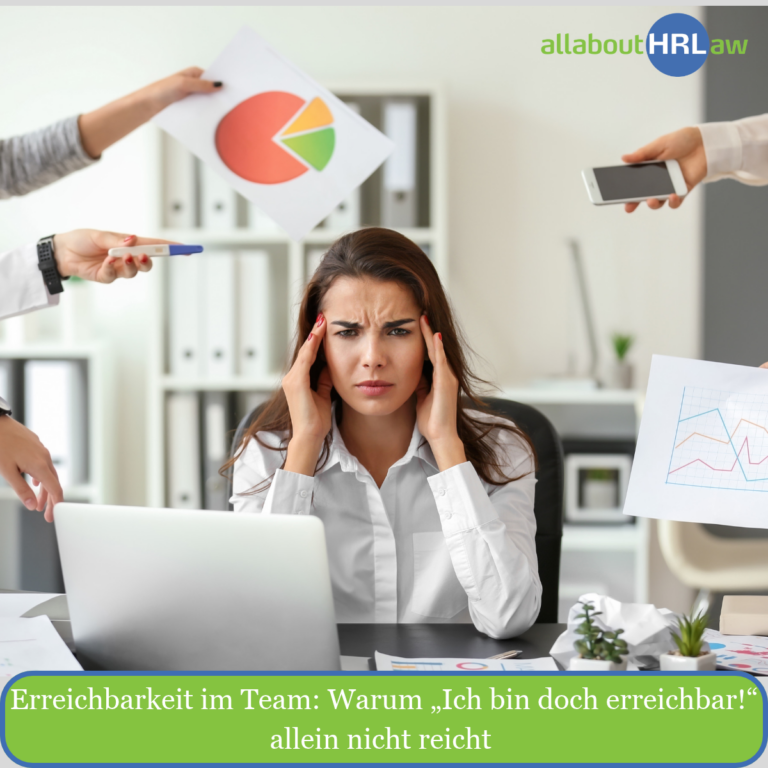
Tuesday morning, just after nine. An employee is working on a task she finally has some quiet time for. Her documents are open, her thoughts are organised, and she has a promising approach.
Then a message pops up.
“Have you got a minute?”
She doesn’t reply straight away. Ten minutes later, a question mark follows. Shortly afterwards, her phone rings.
“I just wanted to check whether you’d seen my message.”
She has. She just wanted to finish her train of thought first.
At the other end, a colleague is waiting for some information. He doesn’t know whether his question has reached her or when he’ll be able to move forward. His work has stalled. She’s now dealing with her third interruption.
Both want to get things done. Yet both end up feeling a little frustrated.
That’s why team availability means more than keeping your phone switched on. There’s a difference between “You can get in touch” and “I’ll reply immediately” that we rarely discuss in our day-to-day work.
Team Availability: What Exactly Does “Quick” Mean?
“Could you take a quick look at this?”
A friendly question. Unfortunately, it’s not a particularly precise one.
Does it mean checking a sentence? Reviewing an entire proposal? And is the feedback needed before the next meeting or at some point during the week?
The person asking usually has a fairly clear idea. The person receiving the request initially has little more to go on than the word “quick”.
That’s how two different timelines emerge for the same task. While one person plans to review it that afternoon, the other is already checking their inbox for the third time.
One extra sentence could help: “Could you please review the highlighted section by noon tomorrow? I’d like to send the draft out afterwards.”
It sounds unremarkable. And it is. But sometimes, effective team availability comes down to details like these.
Not every message needs a lengthy explanation. But if you have a specific expectation, it helps to share it.

The Green Dot Isn’t Doing the Work
A quick glance at Teams: your colleague is online.
So she should be able to reply, right?
Perhaps she’s in a conversation. Perhaps she’s checking figures or preparing for a meeting. Perhaps she’s simply in the middle of a task that needs more attention than she can give it while half-reading a document between chat messages.
The green dot knows none of this. It doesn’t show a packed calendar or a thought someone is trying to hold on to.
Yet we’re quick to interpret “online” as “available”. And when no reply comes, that can sometimes turn into: “Apparently, there’s no time for my question.”
Those everyday clues are often missing when we work remotely. We can’t see someone poring over documents or tackling a difficult task.
When it comes to team availability, a status indicator can offer some guidance. It cannot tell us how much work someone is doing or where their attention is.
And honestly, who wants their working day to be judged by how rarely their status turns yellow?

When Being Helpful Takes Over Your Calendar
Of course we’re happy to help. Finding a template, answering a question, helping someone phrase something — it’s all part of working together.
But sometimes, a working day gradually becomes almost entirely made up of these moments.
A colleague needs some information. Then there’s an impromptu discussion. Next, something needs a quick check. By the time things settle down, the next meeting is starting.
By the afternoon, you’ve helped with plenty of things. Your own task is exactly where you left it that morning.
This isn’t necessarily a matter of poor organisation. Often, every incoming request has simply been given automatic priority.
Effective team availability therefore needs to leave room for focused work, too. It should be possible to finish a task without repeatedly having to explain that you are, in fact, working.
“I’m working on an analysis at the moment and will get back to you by 2 p.m.” gives the other person a clear timeframe. They can plan their next step, and your own task gets the attention it needs as well.
Team Availability Needs a Way to Handle Truly Urgent Issues
Of course, some things really can’t wait until the afternoon.
A new colleague is standing outside a locked door. An important piece of information is missing just before a meeting. Or someone genuinely cannot move forward without a decision.
In those situations, everyone needs to know how to reach the right person.
Problems arise when a question about something happening in two weeks arrives in exactly the same way as an issue that is holding up the entire workflow right now. In the same chat, with the same “Have you got a minute?”
Then everyone has to keep working out for themselves what is urgent.
A simple agreement can help with team availability: which channel should we use for which kinds of requests? When does a phone call make sense? And who can help if the first point of contact isn’t available?
This doesn’t have to become an extensive rulebook. A brief discussion and a shared agreement are often enough.
What matters is that “urgent” retains a clear meaning. If every question prompts an immediate phone call, it becomes harder for everyone else to recognise a genuine exception.
Working Together Doesn’t Have to Mean Working at the Same Time
One colleague starts early; another works later. Someone works part-time, while the manager spends the morning in back-to-back conversations.
That doesn’t mean everyone has to be at their screen at the same time for work to move forward.
This is where asynchronous collaboration comes in. The term may sound a little cumbersome, but the idea is simple: one person prepares something so that another can pick it up later.
That requires clear handovers.
“What do you think?” may leave quite a few questions unanswered. What is this about? Which version is current? What exactly needs reviewing?
“Please add your thoughts on the induction process to the highlighted section by Thursday. I’ll then finalise the plan” makes the task much clearer.
Team availability also depends on how well we enable each other to carry on with the work.
That includes taking different working hours into account. If you message a colleague after she has finished for the day, you should plan for her reply to arrive on her next working day. Messages can be sent and read at different times — as long as that doesn’t create an unspoken obligation to respond.
How We See It at allaboutHRLaw
At allaboutHRLaw, we’ve worked remotely for many years. How people can work well together without being in the same room is therefore part of our everyday experience.
It matters to us that working relationships stay personal. That means taking an interest, feeling able to ask questions, and sometimes having a spontaneous conversation.
We also believe in being mindful of other people’s time and responsibilities. A quiet chat window may simply mean that someone is concentrating hard on their work.
Our understanding of team availability is therefore closely connected to trust. We want to be able to rely on commitments and speak openly when something needs more time.
We bring this perspective to our work as an external HR department, too. With HR matters, people are often waiting for answers that are personally important to them: what happens next with my request? Who can support me before my employee review meeting? What still needs to be arranged before our new colleague starts?
Not every question can be resolved immediately. In that case, an update that explains the next step helps: “We’re still clarifying one point and will get back to you on Thursday.”
For us, that also means keeping track of the date we’ve promised. Employees and managers shouldn’t have to keep chasing for an answer.
That’s how we aim to support our clients: attentive to the people behind each request and clear about what happens next.
Sometimes It’s Better to Talk Than Keep Typing
And then there are those messages where, by the third follow-up question, it becomes clear that a conversation would be easier.
Perhaps a sentence has been interpreted differently from how it was intended. Perhaps important context is missing. Or perhaps a seemingly straightforward question reflects an uncertainty that barely comes across in a chat.
Particularly with personal matters, a written reply can easily seem more abrupt and less warm than intended.
That’s when it’s worth having a conversation. Asking “Is now a good time, or shall we arrange a time to talk?” also takes the other person’s circumstances into account.
For us, effective team availability means finding the right way to communicate. Sometimes that’s a message someone can answer later, when they have time to consider it properly. Sometimes it’s a scheduled meeting. And sometimes it’s a quick phone call that really does resolve the issue in two minutes.

It’s Okay for a Message to Wait
Perhaps we need to remind ourselves more often that, at first, an unanswered message is simply that: an unanswered message. It isn’t a judgement on our question or a sign that someone is unwilling to help.
The colleague on Tuesday morning wanted to finish her train of thought. Her colleague wanted to know when he could move forward. A clear timeframe for the reply would have helped them both — and probably prevented the question mark and the follow-up call.
Team availability also means feeling comfortable leaving a message for a little while. And, in turn, trusting that your own question will get the attention it needs, even if the answer takes a little longer.
What’s it like in your team: can a message wait a little without someone at the other end getting restless?