
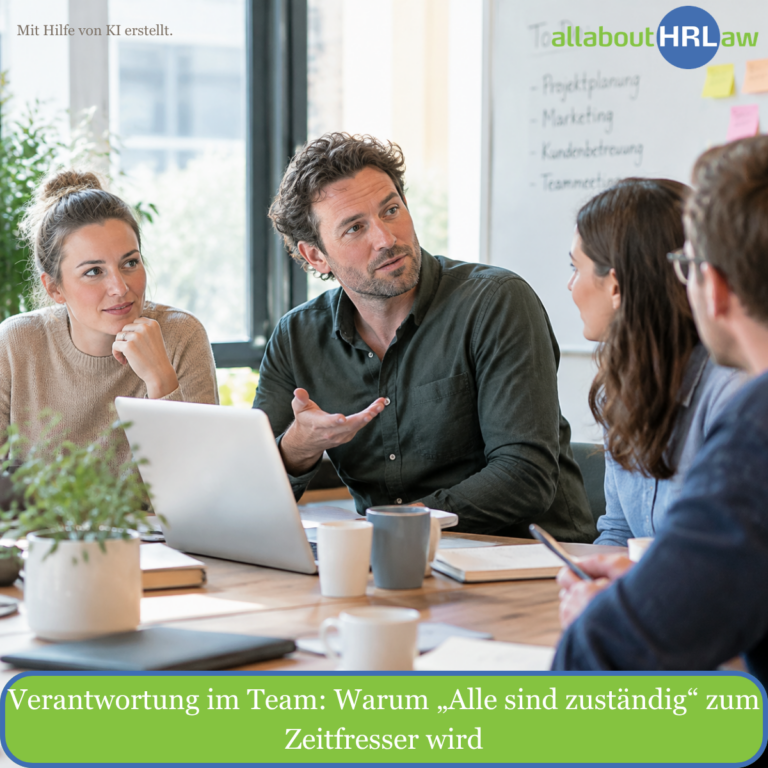
Monday morning, 9:15 a.m. The team is gathered, the coffee is ready, and everyone is discussing the week’s tasks. A new project is coming up, a few practical details need sorting out, and somewhere there is still a decision pending from the last meeting.
“Who’s actually taking care of that?”
“We can do it together.”
Everyone nods. Sounds good! After all, people want to support one another without unnecessarily adding to anyone’s workload. A week later, the topic comes up again.
“Where are we with that?”
A brief silence. Then: “I thought you were doing it?”
Welcome to one of those situations where everyone is responsible, yet no one has taken the next step. Especially in small, growing businesses, responsibility in teams can get caught between good intentions and busy calendars.
This matters to us in HR, too. Because behind an outstanding task, there is often a person waiting for something: their first day at work, a decision, or simply a response they can count on.
Responsibility in Teams: When the Pieces of Onboarding Don’t Come Together
Imagine a company with 25 employees. A new colleague is starting in two weeks. Their manager is planning the training they will need for the role, the office team is organising their workspace, and IT is setting up their laptop.
Everything is on track. At least, that is what everyone assumes.
On the first day, the laptop is there, but access to an essential system is missing. An onboarding plan has been prepared but has not yet been sent out. And the colleague who was going to welcome the new employee is in a client meeting.
Of course, someone finds a solution. A colleague steps in, calls IT, and starts by introducing the new arrival to the rest of the team. Somehow, the day works out. But between last-minute arrangements and “Just a moment, let me check,” it probably does not feel particularly welcoming.
The people involved had all done some preparation. What was missing was the connection between their tasks: who checks before the start date that everything is in place?
For us, responsibility in teams also means keeping an eye on these handovers. One person does not have to do everything themselves. But they should know what is still outstanding and who to speak to about it.

“I Thought Someone Else Was Doing That”
Sometimes, a task is never completely abandoned. Instead, it moves from one person to the next without making any real progress.
An employee wants to develop her skills and asks her manager about a training course. The manager thinks it is a good idea and asks senior management about the budget. They need more information about the time commitment. The request is sent back, gets lost among other messages, and goes unanswered.
Three weeks later, the employee is still waiting.
Several people have discussed her request internally. But none of that has reached her. She knows neither whether the training will be possible nor when she can expect an answer.
That is precisely the difference we pay attention to: what does a process look like from the inside, and how does it feel to the person it is meant to support?
A quick update would not have replaced the decision, but it would have given her some clarity: “We’re still confirming the budget. We’ll get back to you by Thursday.”
This is how responsibility in teams becomes tangible in everyday work. What matters to the employee is knowing that someone is looking after her request and that she does not have to keep chasing it herself.
Why Responsibility in Teams Needs to Evolve as a Business Grows
Small businesses thrive on keeping things simple. People know one another, call across the desk, or clear something up the next time they talk. That closeness is a strength.
As the business grows, however, the circumstances change. New colleagues are not yet familiar with the informal arrangements that have developed over time. Managers are looking after larger teams, information is spread across more conversations, and not everyone hears about every decision.
Suddenly, a familiar way of working no longer runs as smoothly as it used to.
That is no reason to turn every little thing into a formal process. But it is a good moment to take a closer look: which arrangements still work? Where are we assuming knowledge that no longer everyone has?
Responsibility in teams then often comes down to a few deliberately agreed basics: a clear point of contact, an understandable next step, and somewhere people can find important information.
That helps collaboration stay personal even as the company gets bigger. New employees can find their feet without first having to work out who they should “probably just ask” about each topic.
The Colleague Who Somehow Always Knows Everything
Almost every team has one: the person who can find the documents, remembers to follow up, and still knows what was agreed three months ago. When something is unclear, everyone asks her. When something slips through the cracks, she often takes care of it herself.
It works surprisingly well. Until she takes two weeks off.
Suddenly, no one can access a template. Nobody knows who is organising the next induction session. And a question remains unanswered because the crucial information apparently exists only in her inbox.
These situations develop gradually. A helpful person takes on an extra task, solves a problem, and becomes the person everyone asks next time. Eventually, the task feels like hers, even though that was never agreed.
Responsibility in teams should not automatically fall to the people who find it hardest to say no.
That is why it is worth looking at this invisible work. Who keeps things running? Who reminds people, organises things, and follows up? And has time actually been set aside for that work?
For us, good HR means recognising these contributions and working together to find a sustainable way of sharing the workload. That includes cover arrangements and information others can access. Anyone taking time off should be able to trust that important matters will keep moving.

One Question Before the Meeting Ends
Sometimes, a good discussion already feels like a finished result. Everyone has shared their perspective, an idea has taken shape, and the meeting ends with: “Great, let’s do that!”
Back at their desks, though, people discover they have different expectations. One person is waiting for approval, another for a proposal. A third thought the matter was already settled.
A quick check together can help: What has been decided, who is taking the next step, and by when?
The answer does not need elaborate documentation. A brief note wherever the team already works may be enough. What matters is that everyone leaves with the same understanding.
And what if the person responsible is not yet able to make a decision? Then they need to be able to raise that and get support in time.
Because people can only take responsibility within a team if they also have the information, time, and scope to act. Putting a name next to a task does not solve the problem on its own.
How We See Collaboration at allaboutHRLaw
These everyday situations go a long way towards explaining our approach to HR.
At allaboutHRLaw, we support start-ups and small and medium-sized businesses in Germany and the Czech Republic as an external HR department. We handle operational HR tasks and help develop structures that fit each business.
Before changing how things work, we want to understand how a team actually operates. Who can employees turn to? Which issues regularly end up with senior management? And where are people already doing a great deal behind the scenes to keep things running?
We also want to know what works well and should be kept. A personal conversation or a quick, informal discussion does not need replacing simply because the company is growing.
We want to ease the pressure where HR matters are taking up unnecessary time or leaving people waiting for answers. That might mean coordinating the different parts of onboarding, managing job applications, or helping a manager prepare for an employee meeting.
Our aim is to think and act like an in-house HR team: see how things connect, raise outstanding issues, and follow through on agreed actions.
To do that, we agree with our clients what we will take on, which decisions remain within the business, and when we need feedback. For us, that clarity is part of a working relationship both sides can rely on.

Responsibility in Teams Also Requires Trust
Anyone who takes responsibility will eventually overlook something or misjudge a situation. Even good agreements cannot prevent that entirely.
What matters is what happens next. Can someone openly say that a deadline is no longer realistic? Do they flag missing information early? Or do they first try to handle the problem alone?
We believe there needs to be room for these conversations. When something stalls, we want to understand why and what would help now. Perhaps a handover was unclear, a decision was missing, or the task was simply too much to manage alongside day-to-day work.
Responsibility in teams also means asking for support in time and adjusting the approach together.
That fits with how we see HR: close to people, attentive to everyday working life, and open enough to discuss difficulties. For us, reliability comes from clear commitments and honest conversations when things do not go to plan.
Back to Monday Morning
The team is gathered again. There is a task on the table that involves several people.
“We can do it together.”
This time, someone asks: “Sounds good. Who’s keeping track of it?”
One colleague takes on the coordination. The others know what they will contribute, and together they agree on a realistic deadline. An outstanding issue is raised straight away rather than left as an unspoken assumption.
A small agreement that changes what happens next.
That is how we see responsibility in teams: people support one another, tasks have a clear home, and no one has to hope that someone will get around to them.
That is exactly what we want our work to contribute to. So that senior management, managers, and employees know who to turn to with their HR matters and feel well supported.
To find out how we put this into practice as an external HR department, visit our About Us page.